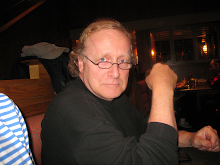
In "Odysseus in America: Combat Trauma and the Trials of Homecoming," published in 2002, Shay draws parallels between the perilous, 10-year journey home of Odysseus from the Trojan War and the psychological odyssey of veterans returning to civilian life.
Like the hero of the "Odyssey," whom Shay depicts as conniving and explosively violent as he travels the world battling monsters, veterans of contemporary wars are often danger-seekers.
In his book, Shay cites the example of a Navy veteran from South Boston who was the only member of his boat crew to survive an explosion in the Mekong Delta on March 17, 1968, during the Tet Offensive. For years on the anniversary of
the explosion, this veteran, whom Shay calls Wiry, "would go into a really rough
fighting bar in Southie and just attack the meanest, toughest-looking guy in the
bar and get himself beat up," Shay told the Globe.
Today, troops returning from Iraq and Afghanistan tell similar stories about their mental struggles. Shay believes that the analogies he draws in his books can be useful to help reduce and treat psychological trauma among those veterans.
"As long as human beings go to war and try to come home from war, these [epics] will speak to us," he said of the "Iliad" and the "Odyssey." "They truly hold up all that is generic about going to war and coming home from war."
Shay's books are "a wonderful resource for both clinicians and vets and their loved ones," said Keith Armstrong, a San Francisco psychiatrist and one of the authors of "Courage After Fire," a guide book on coping with trauma for troops who are returning from Iraq and Afghanistan and for their families.
Tuesday, September 25, 2007
confronting our monsters, quieting our demons
Psychiatrist receiving MacArthur fellowship drew from Homer to treat war veterans - The Boston Globe -- This repatriation following a stint in the service has proven a problem for many of us, our friends, and our families. Here from the Boston GLOBE is a story of a psychiatrist who has made a connection I never thought of; PTSD and allied problems seem to be perennial, but treatable. We are not alone.
Labels:
infinite love,
integralism,
PTSD,
repatriation
editing the editors, adjusting the attitude
Burke Lakefront Airport isn't going anywhere, so city must make the best of it - an editorial- cleveland.com -- I thought it was an incredibly good piece of news that Frank Jackson was acknowledging the permanent status of Burke Lakefront Airport, acknowledging that the dialogue swirling around it was something that never should have been started. As a development asset, it was never something that could ever be put on the table. I would really like to know who started beating the drum about it in the first place.
Anyway, we have below a PD editorial, which I have included in its entirety, that points up the attitudinal shortcomings of our newspaper's vision of who we are and what capital we have as a city and as a region. This editorial is about as shabby as the PR flak job they tried to pass of as reporting of the abrogation of our voting rights with last sales-tax-hike, the one that starts October 1st.
A far more positive take would be that the builders of Burke created usable land where there had been none prior. They created an asset of value using garbage. They were early-adapter recyclers. They were The Forest City, and they were green, too.
Another positive point is that dealmakers can fly into Burke discreetly, be whisked up to corporate or professional offices where big deals are made, and be taken out to wine and dine in celebration of the closed deal at classy hotels and restaurants before being whisked back down to the field to depart for home. WORTH Magazine has been attentive all this year to how people are using small planes--leased, shared, bought, and so forth.
Yet another positive point is that very few other cities have an asset like this, collocated with the fanciest hotels and the main business district with all the corporate headquarters and big law firms.
Another interesting fact is that this little airport takes the shipping burden off Hopkins and can handle a heck of a lot of courier business from the downtown business district.
Another neat thing is that our airport is nestled right between Edgewater Park and Whiskey Island to the west and Gordon Park and Bratenahl to the east. Really, how much "access" does the PD editorializer want? What about that Stadium thing? We had the chance to redesign the lakefront during the final days of the White administration, and where was the PD when that was all kicking off?
Since the PD's content usually disappears after a while, here is the editorial in all its cheesy, yet resplendent, negativity. See how you would make it more positive, try shucking the Ambrose Bierce pose without becoming Holly Golightly or Mary Poppins. The bold parts are things I think could stand an attitude adjustment, or some backup with facts.
Friday, September 21, 2007
Mayor Frank Jackson's announcement that Burke would remain open indefinitely was probably the right decision.
Seventy years ago, when Cleveland's city fathers were looking around for land on which to build a new airport, they made a horrible decision.
Booming business at Cleveland Municipal Airport (now Cleveland Hopkins International Airport) was creating a desperate need for a reliever airport to handle smaller aircraft. So, city officials looked around and settled on the worst possible site - the city's lakefront.
World War II delayed construction, but by 1947, enough waste, garbage and other fill had been piled on the Lake Erie shoreline to open Burke Lakefront Airport, a 480-acre land-grabber that has blocked access to Cleveland's most precious asset ever since.
Almost from the day it opened, Burke has been cited as an example of atrocious land-use policy. But calls for closing Burke have often conveniently ignored the enormous difficulties that would be involved.
Replacing Burke with an airport located more sensibly would cost hundreds of millions of dollars, if not billions.
Redirecting light aircraft to Hopkins would risk intolerable delays to the major air carriers so important to the region's economy.
Any move to close Burke would probably meet fierce resistance from the Federal Aviation Administration.
For all of those reasons, Wednesday's announcement by Mayor Frank Jackson that Burke would remain open indefinitely was probably the right decision. Wisely, the mayor also wants to increase development around Burke, an idea that could be facilitated by moving the port and Coast Guard headquarters. Smart development near Burke would not only represent a first, but would be consistent with the long-term lakefront plan advocated by
Jackson's predecessor, Jane Campbell.
But if Burke is to remain, it is essential that it be turned into an honest-to-goodness airport that serves the city's needs - not just a little-used landing strip serving a few dozen corporate jets and student pilots.
Until that changes, Burke will continue to be a complete waste of priceless lakefront land. The burden now falls to Jackson and airport director Ricky Smith to make the best of Burke's bad location by implementing their good ideas.
Monday, September 24, 2007
Ken Burns: The War
I don't usually watch much television. For some reason, last night we locked onto our local PBS station, Channel 25, and stayed locked on through the second showing. Ken Burns' THE WAR is history dished up as never before as well as a think-tool for dealing with today's state of affairs, in which much of the money and the power seem to have gotten into the wrong hands.
There are two recurrent, simple, powerful themes that reached from then to now and grabbed me:
- Bad things happen when one group of people thinks it's better than or superior to another group.
- Worse things, evil things, ugly things, happen when the group that thinks it's superior begins to covet and then confiscate the stuff of the supposedly inferior group.
Here's a synopsis of the episodes and a schedule. Back then, the people had information withheld from them, but they seemed to be trying to come awake. Now, we have imperfect information fed in from all sides, despite our mainstream media's vastly improved capabilities, but people seem not to want to come to grips.
Thursday, September 20, 2007
#4

Task Lamps in the Spotlight - New York Times -- I'm fascinated with lamps and light. Without good lighting, you have trouble living in the world of books, art, and ideas. With good lighting, the world opens up.
I also think that paying attention to having good lighting is important for maintaining our full functionality for as long as possible.
I think I really want #4, Richard Sapper’s Halley Compact lamp.
I also think that paying attention to having good lighting is important for maintaining our full functionality for as long as possible.
I think I really want #4, Richard Sapper’s Halley Compact lamp.
Labels:
art,
design,
holistic practices,
lighting,
vision
Tuesday, September 18, 2007
Roldo reports on Gloria's reporting the truth, out-reporting the PD/Lesic PR staff
CoolCleveland.com - Roldo Link Reporters Snooze To Avoid Displeasure Of Bosses --George over at BFD gives us the heads up on Roldo's commentary this week in which he takes note of Gloria's depiction of the county hearings on the sales tax, and contrasts it to the work done by the PD reporters and editors. It makes me wonder why the PD couldn't afford to be more forthcoming, more "journalistic." In the case of the sales-tax hike for the general fund, they functioned as a public-relations agency for the commissioners and the Greater Cleveland Partnership, not as a newspaper. If ever they felt they were charged with reporting the truth in a balanced manner, they seem to have forgotten.
Labels:
betrayal,
BFD,
buggery,
conflicts of interest,
CoolCleveland,
duplicity,
public interest
open source, open economy
I.B.M. to Offer Office Software Free in Challenge to Microsoft’s Line - New York Times -- Good news here, as IBM announces that Lotus line will go open source in direct competition with Microsoft Office. I ran IBM's OS/2 for years because it was a solid system that attempted to allow compatibilities across platforms. The whole idea was that we be functional, secure, and able to communicate. Microsoft won out in the operating-system wars by being exclusive, proprietary, and marketing-savvy. They also sabotaged everybody else's standards in order to achieve dominance. Since then, having become the only game in town for business applications, they have proceeded to extort us.
IBM has been offering Lotus on its machines for a good while. We're looking to buy a refurbished IBM-certified machine, and they still come with Lotus SmartSuite on board.
Another bright spot in the open source arena is Ubuntu, which people are comparing to a lean, stripped-down Windows XP. LAPTOP Magazine's Jeffrey Wilson ran a good bit on it in the September 2007 issue; the print edition has less than the online link I've furnished, and they're different.
The point is that we will now be able to whack about $200-300 off the cost of every machine. We will be able to get high-quality refurbished equipment into the hands of just about everybody in our communities. With tactical deployment of wifi, we will all be able to build our own community networks. We will be able to do an end-around and to go faster than those who now are blocking progress, to hold onto their vested interests. Soon, everybody will have "access." It sounds really American.
I shrugged and said what the heck
Ayn Rand’s Literature of Capitalism - New York Times -- I confess that I haven't read any Ayn Rand straight through. I tried years ago, and it didn't speak to me, so whichever work it was never got finished. Reading this reprise by the NYT, I think her writing might be a propos to the times we're in now, so I'll be picking up a copy of Atlas Shrugged soon. One of our very good friends down in Worthington tells us it was a seminal influence on his life and his career, and we think he's done a good job of balancing spirituality and money.
Labels:
economic development,
economics,
enterprise,
knowledge economy,
money
Saturday, September 15, 2007
please note that Michael has moved
Meet the Bloggers » Midtown Brews: Tech Czar Michael DeAloia -- Here's an exciting exit interview with our Tech Czar, Michael DeAloia, leaving the city government for SchoolOne. I think that, after you listen, you will agree with me that the title of Tech Czar necessarily moves with him. (I have always wanted it to be Tech Tsar, because there may be such a thing as visual alliteration.)
People go where they're appreciated.
there are givers, and takers
This morning, I am reading Stephen Post's new book and have come across the concept of "generativity" and how it promotes health and prosperity. Here's a section about David Sloan Wilson that I find especially a propos with regard to our local economy and the dialogue we've been having these past few years about casinos, the medical mart, and development in general. The following comes from pages 59 and 60:
...In particular, I've turned to the evolutionist (and my friend) David Sloan Wilson, author of Darwin's Cathedral. David is the brilliant thinker who resurrected Charles Darwin's idea of group selection to explain why we give and why we enjoy giving. He has pointed out that groups whose members are giving actually survive and flourish. Imagine a world, says David, that ranges from the most pristine giving to the most wanton selfishness. Winners survive and reproduce and truly "inherit" the earth, while losers pass out of existence. So who are the winners and losers? You'd think givers would lose in such a world, because they would constantly be taken advantage of. But givers thrive--as long as they interact with other givers. The band together in generous, caring groups and thrive. Over time, David suggests, evolution has slowly selected giving as a profoundly healthy trait in our very social species.
Labels:
gangsterism,
generativity,
giving,
greed,
MeetTheBloggers
Friday, September 14, 2007
consolidations to Cleveland?
KeyBank eliminates call center, 200 jobs -- Just keeping you posted, from our neighbors in Dayton:
KeyBank is the second Cleveland-based bank to cut jobs and slash operations in the Dayton area recently.
National City Corp. announced last week that it is cutting nearly 1,300 jobs to shrink the bank's faltering mortgage business. More than 100 employees at National City Mortgage in Miami Twp. were laid off as a result.
Subscribe to:
Posts (Atom)